Temecula DSP MDV-II & MCV-I
The studio workhorse that defined affordable digital effects × 2 and The bedroom producer's secret weapon

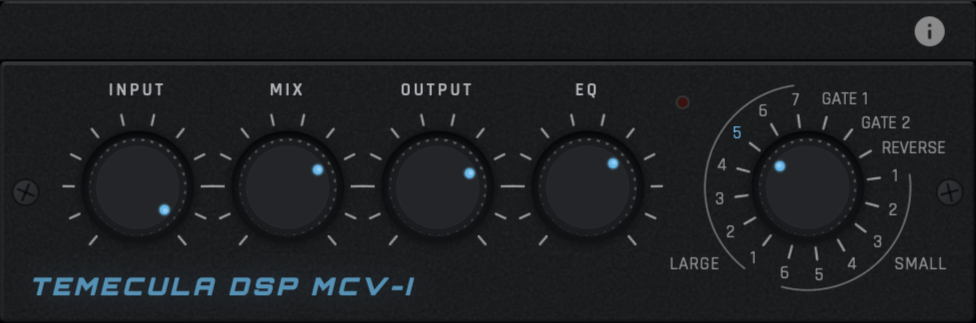
One Two Chips. 100 Programs. Unlimited Character.
There are two types of producers: those who think this reverb sounds "too colored," and those who refuse to mix a track without it. We meticulously recreated this cult-classic unit because sometimes, perfection is boring. You use it when you want your synth to float in space, your guitars to smear into a lush nostalgic wash, and your mix to have a sound that's unmistakably its own.
MCV-I & MDV-II are FREE!
(Don't let "free" fool you — these are two of my favorite effects. Because they're so easy to use, and Keith Barr's algorithms sound incredible!)
VST3
|
AU
|
AAX
I played an acoustic guitar to it and then it's basically an Alesis Midiverb II, it's the reverse reverb program. If I ever had a secret weapon it's the Alesis.
- Kevin Shields, My Bloody Valentine (Tape Op)
And if you like two engines, try four. Meet the DEEP/4— our Ensoniq DP/4 recreation.
Hear the Character
Each source includes a dry (unprocessed) sample followed by various programs from the MDV-II across reverb, gate, reverse, flange, chorus, delay, and multi-tap effects.
MDV-II Features
Seven Categories of Classic Effects
All 100 factory programs are included, organized into seven categories that cover every effect type the original hardware offered.
| Category | Programs | Description |
|---|---|---|
| Reverb | 01–29 | Small, medium, and large rooms from bright to dark, plus extra-long ambient decays |
| Gate | 30–39 | Slow and fast gated reverbs for punchy drums and percussive sources |
| Reverse | 40–49 | Reverse reverbs and regenerated reverse effects for atmospheric swells |
| Flange | 50–59 | Triggered flanges and stereo panning flanges with triangle-wave LFOs |
| Chorus | 60–69 | Light to deep chorus with sine-wave modulation for thickening and shimmer |
| Delay | 70–89 | Fixed delays from 35ms to 460ms, multi-tap, and regenerated echo up to 4 seconds |
| EFX | 90–99 | Stereo generation, thickening, multi-tap ambience, and frozen flange |
Dual DASP-16 Engine
The MDV-II goes beyond the original hardware with two mathematically modeled DASP-16 chips running in series. Unit A feeds into Unit B, so you can stack a reverse reverb into a chorus, run a gated verb into a delay, or chain any two of the 100 programs together. Each unit has independent program selection, mix, and bypass controls.
Pan-Spread Stereo
Each unit has its own pan control. With both pans centered, the signal runs as a pure series chain — you hear the combined result of A into B. Spread the pans apart and the two stages separate in the stereo field, letting you place each effect independently. It's a smooth crossfade from stacked mono to wide stereo.
Faithful DASP-16 Emulation
The heart of the MidiVerb II is the custom DASP-16 (Digital Audio Signal Processor) chip designed by Keith Barr. The MDV-II faithfully recreates this chip, reproducing the signal flow of all 100 factory programs at the original 31,250 Hz internal sample rate. Every program produces the same output as the original hardware — including its characteristic warmth and bandwidth-limited charm.
Vintage Mode
Toggle vintage mode with the fuse icon in the toolbar to drop the internal engine from 44.1 kHz down to the original hardware's native 31,250 Hz sample rate. This lowers the Nyquist ceiling to ~15.6 kHz and stretches reverb tails and delay times to match the original unit, reproducing its characteristic darker, softer tone.
Intuitive Controls
Input Level, Mix, Pan, and Output Level knobs give you precise control over signal flow. A/B buttons switch between the two engines, each with its own program, mix, and pan settings. A per-unit bypass button lets you disable either engine independently. The two-digit numeric keypad, arrow buttons, and drag-to-scroll LED display make program selection fast and familiar. All parameters are fully automatable in your DAW.
The History of the MidiVerb II
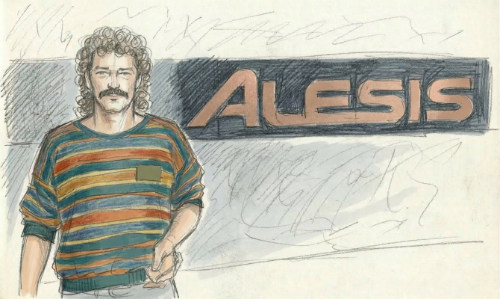
Keith Barr, co-founder of Alesis and designer of the DASP-16 chip.
In the mid-1980s, Alesis set out to democratize professional audio effects. Digital reverb units from Lexicon and AMS cost thousands of dollars and were found only in top-tier studios. The original MidiVerb broke new ground by offering digital reverb in an affordable, compact format. The MidiVerb II followed shortly after, expanding the concept with a dramatically larger program library, improved sound quality, and a more versatile control set.
The MidiVerb II found its way into countless home and professional studios throughout the late 1980s and 1990s. Its combination of instant-recall preset access, MIDI integration, and genuinely musical effects made it a workhorse for tracking and mixing alike. The gated and reverse reverb programs became particularly popular for drums, while the chorus and flanging algorithms found a home on guitars, keyboards, and vocals.

At the heart of the MidiVerb II sits the DASP-16 — a custom digital audio signal processor designed by Alesis specifically for this unit. The chip implements a delay-line architecture using 16 kilobytes of dynamic RAM as a circular buffer. Programs are defined as sequences of 128 instructions that read, sum, and write delay taps at precise time offsets within this buffer. This single-chip design is what allowed Alesis to offer the MidiVerb II at its breakthrough price.
The MDV-II plugin faithfully reproduces this architecture at its native sample rate of 31,250 Hz, preserving the warm bandwidth and subtle character that made the hardware a studio staple. The unit's characteristic warmth — a product of its limited bandwidth and integer arithmetic — became part of its appeal rather than a limitation.
Press
© 2026 Temecula DSP.
SST-282, SST-206 and Stargate 626 are model numbers originally used by Ursa Major and Seven Woods Audio. Temecula DSP is not affiliated with the estate of Christopher Moore, Ursa Major, or Seven Woods Audio.
DP/4 is a trademark of Creative Technology Ltd. Temecula DSP is not affiliated with, endorsed by, or sponsored by Creative Technology Ltd.
"Alesis" and "MidiVerb" are trademarks of inMusic Brands, Inc. Temecula DSP is not affiliated with, endorsed by, or sponsored by inMusic Brands, Inc.